Looking for the right baby walker for your little one? This guide is for parents and caregivers of babies 6-18 months old who want to make a safe, informed choice.
We’ll walk you through the developmental benefits of baby walkers, compare the different types available, and highlight the critical safety features you need to consider before buying.
Table of Contents
Understanding Baby Walker Benefits and Development Stages
A. When Your Baby is Ready for a Walker
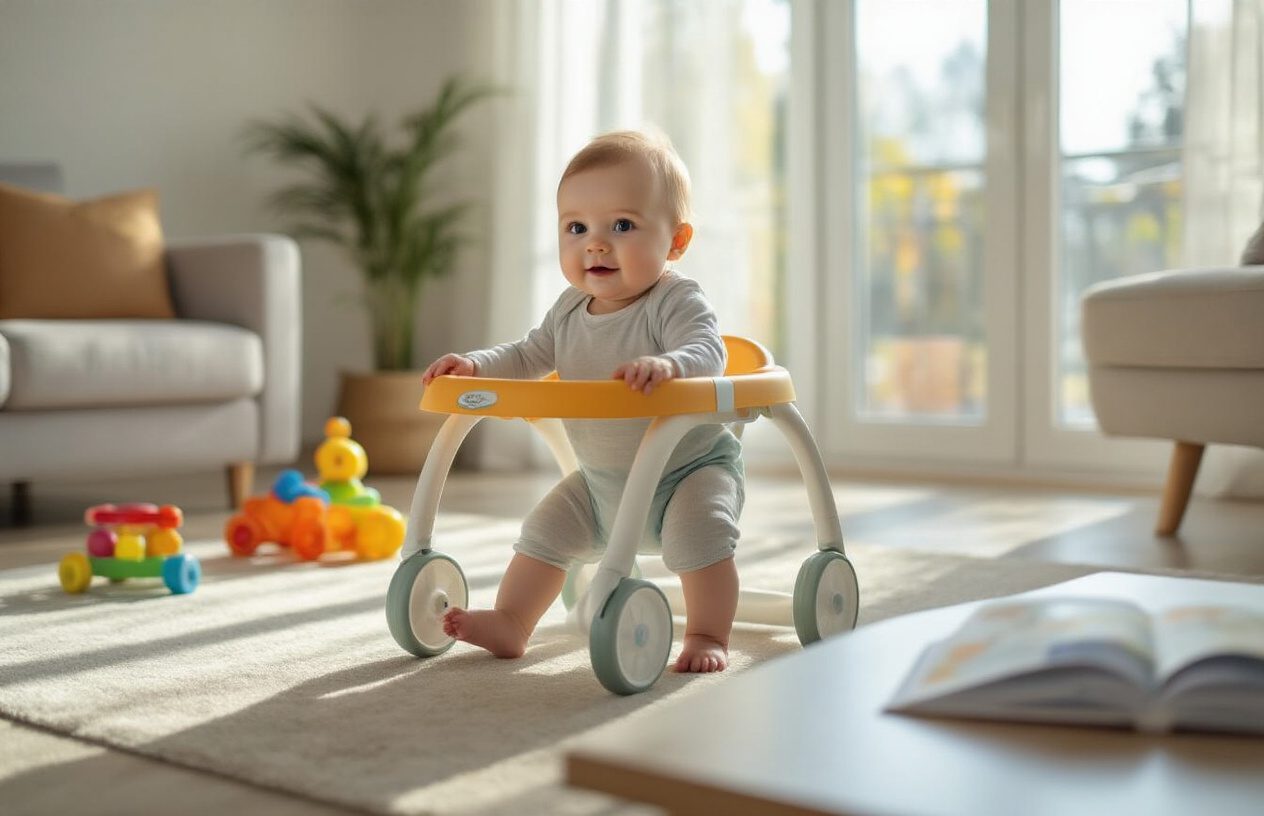
Watching your little one grow is exciting, but figuring out when they’re ready for a walker can be confusing. Most babies are ready to try a walker between 8-10 months old. By this time, they’ve usually mastered sitting without support and are trying to pull themselves up on furniture.
But here’s the thing – every baby develops at their own pace. Some might be eager to move around at 7 months, while others might show no interest until closer to a year. The key is to watch your baby, not the calendar.
Signs your baby might be walker-ready:
- Can hold their head up confidently
- Pushes up on their hands when lying on their tummy
- Shows interest in standing with support
- Tries to move forward when held upright
- Gets frustrated at not being able to move independently
B. Physical Development Milestones to Watch For
Before introducing a walker, your baby needs to hit certain physical milestones. These aren’t just checkboxes – they’re signs your baby’s body is developing the strength and coordination needed for supported walking.
The biggest milestone? Core strength. Your baby needs a strong trunk to maintain proper posture in a walker. When they can sit unassisted for several minutes, that’s a good indicator that their core muscles are developing nicely.
Lower body strength matters too. Look for:
- Ability to bear weight on legs when held upright
- Bouncing movements when standing with support
- Beginning to cruise (moving sideways while holding furniture)
- Attempting to take steps while holding your hands
C. Safety Benefits of Modern Walkers
Today’s walkers are safety powerhouses compared to the ones from even a decade ago. Manufacturers have completely reimagined baby walkers with safety as the top priority.
Modern walkers feature:
- Wider bases that prevent tipping
- Friction strips that stop the walker at steps or thresholds
- Limited speed controls to prevent dangerous momentum
- Activity centers that keep babies engaged without excessive movement
- Adjustable height settings that grow with your baby
The best part? Many newer walkers are actually “seated activity centers” that bounce or rotate but don’t freely move around the house. These stationary options eliminate the falling hazards while still providing the sensory stimulation babies love.
D. How Walkers Support Learning and Exploration: Baby Walker
Walkers aren’t just about physical movement – they’re little learning labs. When your baby can navigate independently (even with support), their whole world expands.
A good walker creates opportunities for:
- Spatial awareness development as babies learn to navigate around objects
- Cause and effect learning (“If I push with my feet, I move forward!”)
- Hand-eye coordination through reaching for toys while maintaining balance
- Sensory exploration by accessing new areas and objects
- Confidence-building through newfound independence
Look for walkers with built-in toys that encourage different types of play – music for auditory development, textured objects for tactile exploration, and colorful visuals for visual stimulation.
The freedom to explore independently often leads to longer attention spans and more focused play, which are critical for cognitive development during this stage.
Key Features to Consider in a Baby Walker
A. Stability and Support Structure: Baby Walker
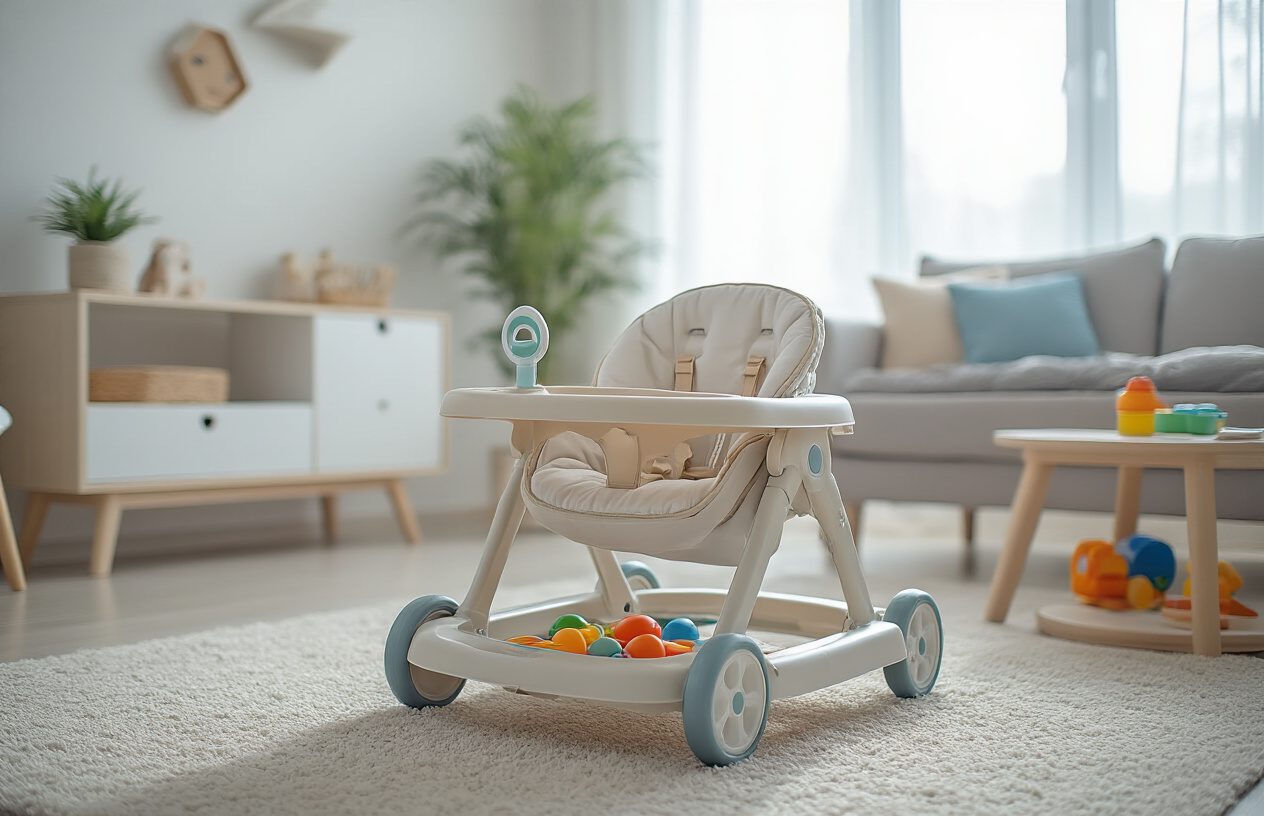
Shopping for a baby walker? Stability should be your top priority. A good walker won’t tip over when your little one leans or bounces. Look for models with a wide base—the wider, the better. This prevents those scary tip-overs when your baby reaches for something.
The support seat matters just as much. It should cradle your baby comfortably while providing proper back support. Some walkers offer additional neck support for younger babies who are still developing those muscles.
Anti-slip features are non-negotiable. Check for rubber stoppers on the base that prevent the walker from sliding on smooth surfaces or tumbling down stairs.
B. Height Adjustment Options
Babies grow at lightning speed. Today’s perfect height is tomorrow’s too-short walker. That’s why adjustable height settings are a game-changer.
Most quality walkers offer 3-5 height positions. This lets you customize the walker as your baby grows, ensuring their feet touch the ground properly—not dangling, not scrunched up.
C. Wheel Types and Movement Control
The wheels make all the difference between a smooth glide and a frustrating struggle. Four-wheel designs typically offer more stability than three-wheel options.
Look for wheels that swivel 360 degrees—they’re easier for babies to maneuver. But here’s the catch: you also want speed limiters or friction controls. These prevent your little speedster from zooming across the room too quickly.
Some premium walkers feature wheels that lock or convert to a stationary mode. This gives you the option to transform the walker into a fixed play station when needed.
D. Entertainment Features and Learning Tools: Baby Walker
Baby walkers aren’t just mobility tools—they’re entertainment centers on wheels. The best ones come with activity trays loaded with age-appropriate toys that develop fine motor skills.
Music buttons, flashing lights, and texture toys keep babies engaged while they practice walking. Some even include removable toy panels that can be played with separately on the floor.
Digital features are trending now—walkers with sound effects, educational songs, and even basic language learning. But don’t go overboard with batteries and noise. Sometimes, simple mechanical toys provide the most developmental benefits.
E. Comfort and Ergonomics
A comfortable baby is a happy baby. The seat padding should be plush enough to cushion their bottom but firm enough to provide support. Removable, machine-washable seat covers are lifesavers (trust me).
Check the leg openings—they should be generous enough to prevent chafing but not so large that your baby slips through. The ideal walker positions your baby in a natural stance that promotes proper posture.
Finally, consider the walker’s weight. While sturdiness matters, you’ll be folding, storing, and possibly traveling with this thing. A lightweight, foldable design makes your life infinitely easier when it’s time to pack up or store away.
Types of Baby Walkers Compared
A. Traditional Seated Walkers
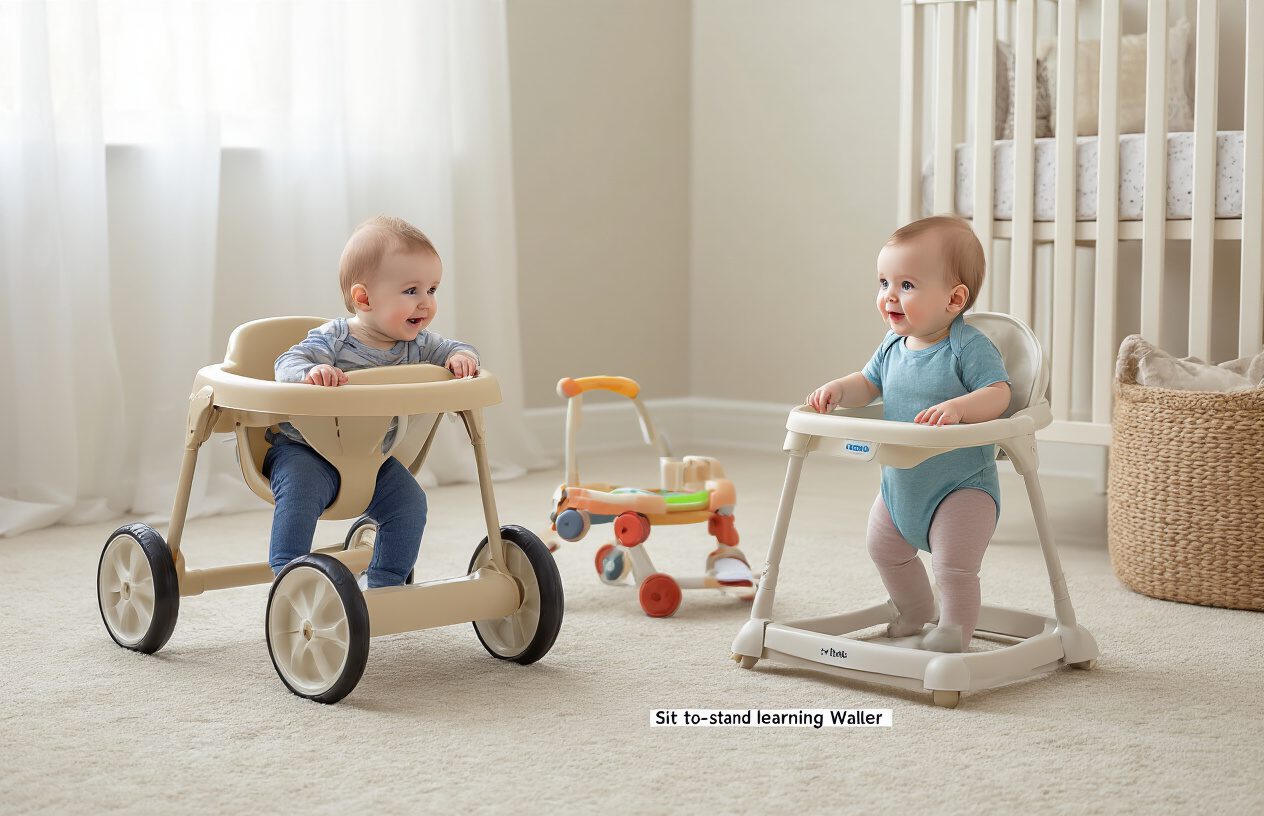
These walkers let your baby sit inside while their feet touch the ground, allowing them to scoot around. They typically feature a plastic frame with wheels and a fabric seat with leg holes. Most come with attached toys and activities to keep little ones entertained.
The good? They’re entertaining and give babies independence. The bad? Safety concerns are real. They’ve been banned in Canada, and health organizations warn against them because babies can tumble down stairs or reach dangerous items. If you do choose one, never leave your baby unattended and use baby gates at the stairs.
B. Push-Behind Walkers
Push walkers are exactly what they sound like – sturdy frames babies push from behind while walking. They’re usually heavier at the base to prevent tipping, and many transform into fun activity centers.
Parents love these because they’re safer than seated models and help babies learn to walk naturally. Your little one controls the movement and develops proper walking skills rather than just scooting around. They’re perfect for babies who are pulling up and cruising along furniture.
C. Convertible Multi-Stage Models
Why buy multiple products when one can grow with your child? Convertible walkers transition from seated activity centers to push-behind walkers as your baby develops. They’re the Swiss Army knife of baby gear!
The best ones adjust to different heights and offer removable toy panels your baby can play with, even when not walking. You’ll get more mileage out of these, though they tend to cost more upfront. Worth considering if you’re short on space or love practical baby gear that lasts.
D. Activity Centers with Mobility Features
These are essentially stationary activity centers with added mobility options. They might spin, bounce, or offer limited movement while keeping the baby secure in one general location.
They’re a middle ground for parents concerned about safety but wanting to give their little ones some independence. Babies can practice standing and taking steps while engaging with toys and activities. They don’t provide the same freedom as traditional walkers but offer development benefits with fewer safety risks.
Safety Considerations for Baby Walkers
A. Meeting Current Safety Standards: Baby Walker
Baby walkers have come a long way since the days of those dangerous metal contraptions our parents used. Today’s standards are much stricter, and thank goodness for that.
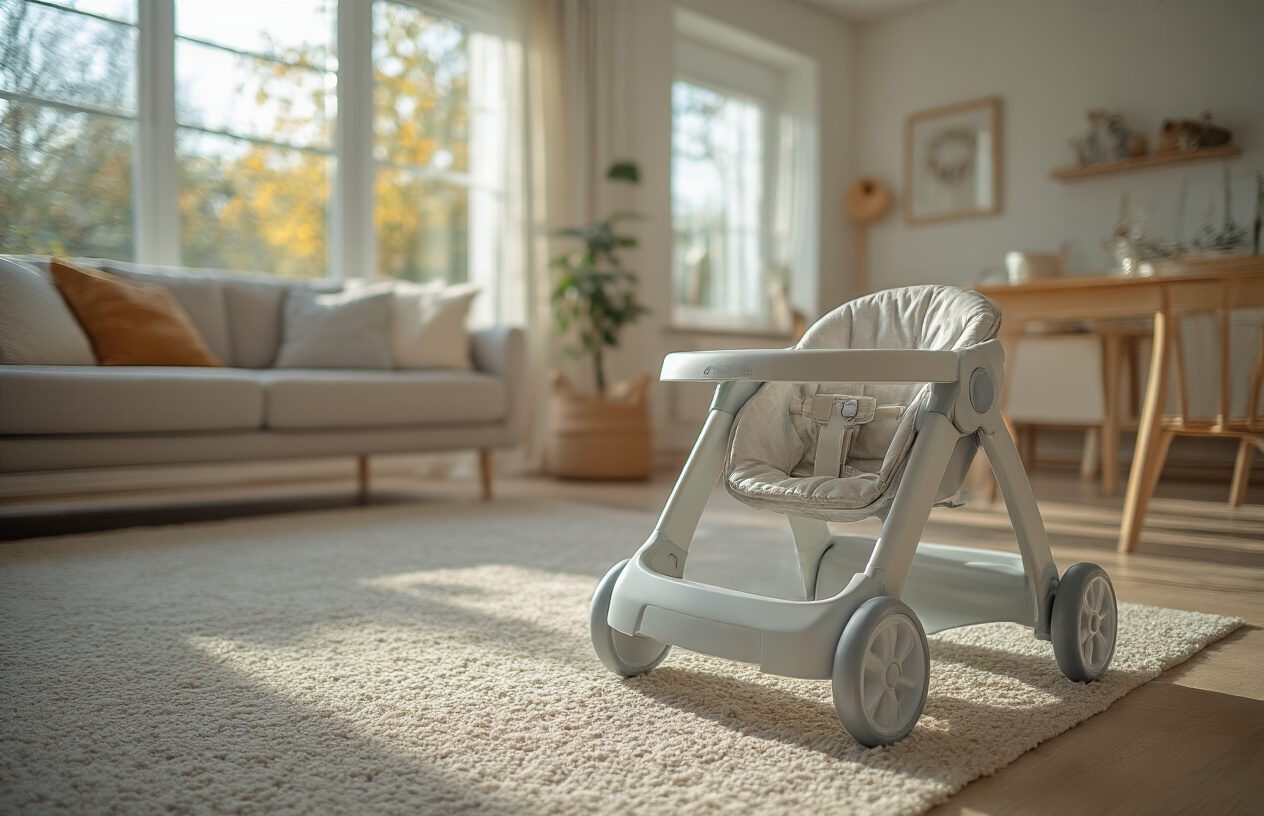
Look for walkers that meet the ASTM F977-12 safety standard. This isn’t just some random set of letters and numbers—you guarantee that the walker has passed tests for stability, sharp edges, and pinch points.
The CPSC (Consumer Product Safety Commission) banned the old-style walkers that were responsible for thousands of injuries. Modern walkers must:
- It is too wide to fit through a standard doorway
- Have features that stop the walker at the edge of a step
- Support your baby’s weight without collapsing
B. Braking Systems and Anti-Fall Features
Ever seen a baby zoom across the floor at lightning speed? It’s cute until they’re heading straight for the stairs.
Good walkers now come with rubber friction strips on the bottom. These little heroes grip the floor when the walker starts to tip over the edge.
What to look for:
- Friction strips that activate when one or more wheels go over an edge
- Wheel locks that you can engage when you need the baby to stay put
- Wide, stable base that resists tipping
- Stationary “parking” mode
My neighbor’s baby was saved from a nasty fall because their walker had these features. Worth every penny.
C. Space Requirements in Your Home
You need more space than you think for a baby walker. Trust me on this.
Most parents underestimate how much room their little speed demon needs to maneuver safely. Your cozy apartment might suddenly feel like an obstacle course.
Minimum space requirements:
- Open floor area of at least 8×10 feet
- No loose cords or cables on the floor
- Secured rugs or no rugs at all
- Gates at the top and bottom of the stairs
- Door thresholds less than 1/4 inch high
Measure your space before buying. That gorgeous walker is useless if your baby keeps bumping into walls or furniture.
D. Supervision Guidelines When Using Walkers
I don’t care what the box says—never leave your baby alone in a walker. Not even for a second.
Even with all the fancy safety features, babies in walkers can reach things they normally couldn’t and move faster than you’d expect.
Smart supervision means:
- Staying within arm’s reach at all times
- Limiting walker time to 15-20 minutes per session
- Watching for signs of fatigue or frustration
- Keeping doors to dangerous areas closed
- Having a “walker zone” that’s been thoroughly baby-proofed
Remember that walkers don’t help babies learn to walk. They’re for entertainment, not development.
E. Common Safety Hazards to Avoid
The dangers aren’t always obvious until you see your baby rolling toward them at top speed.
Hot drinks on low tables? Your baby can now reach them. That houseplant you love? Suddenly accessible. The bathroom door you left cracked open? An invitation to adventure.
Watch out for:
- Hanging tablecloths that can be pulled down
- Toxic plants within reach
- Unstable furniture that could tip over
- Access to bathrooms, kitchens, or laundry rooms
- Small objects on the floor that could be choking hazards
- Heaters, fireplaces, or radiators
- Pets who might be startled by a rolling baby
Practical Tips for Choosing Your Baby Walker
A. Budget-Friendly Options Without Compromising Quality
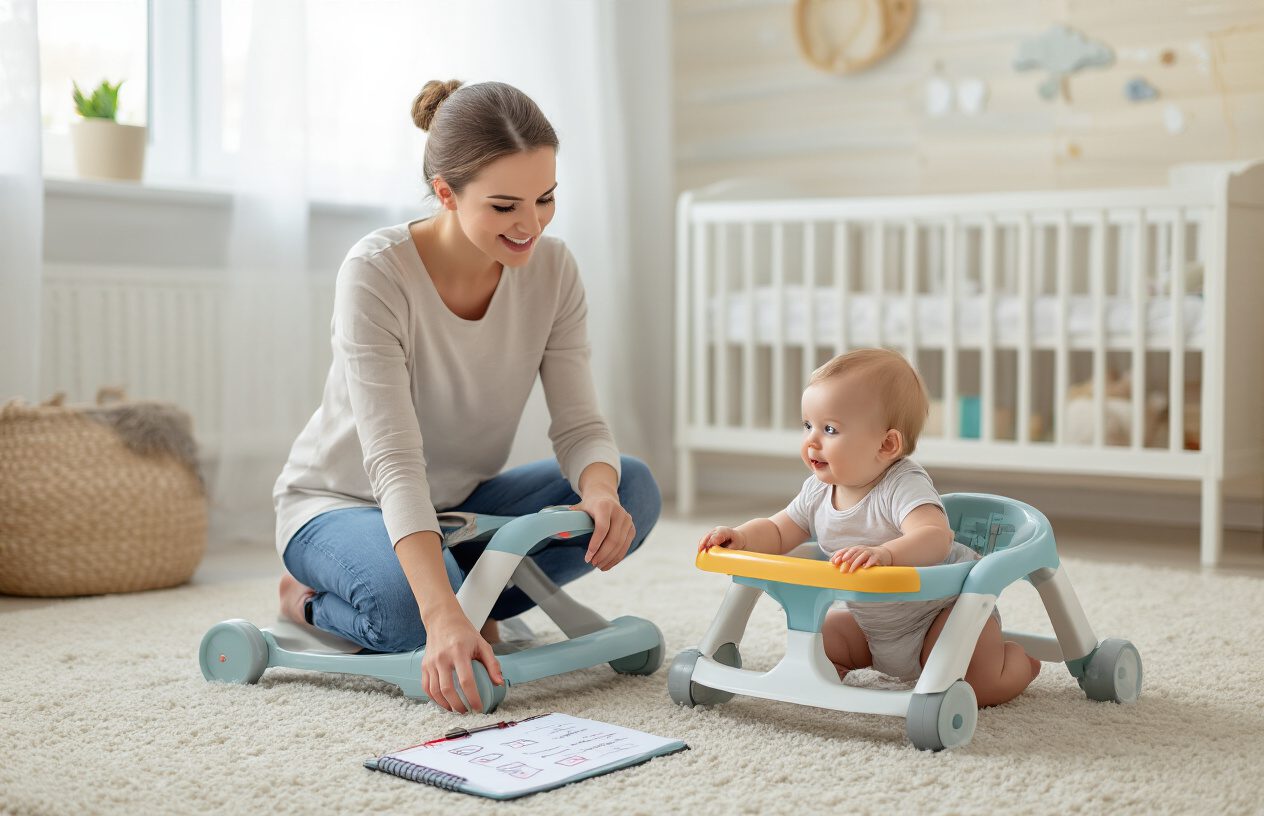
Shopping for a baby walker doesn’t mean emptying your wallet. Plenty of affordable options pack all the essential features without the premium price tag. Look for brands like Bright Starts and VTech that offer solid walkers in the $30-60 range.
The secret? Focus on what matters: sturdy construction, proper height adjustment, and safety features. Skip the fancy electronic panels with 50 different sounds – your baby will be just as happy with a simpler version.
Consider these money-saving approaches:
- Buy during seasonal sales (Black Friday, end-of-season clearances)
- Check for open-box specials at baby stores
- Join parent swap groups on Facebook, where barely-used walkers sell for half price
- Look at convertible models that transform from seated to walk-behind styles
B. Size and Storage Considerations
Baby gear has a knack for taking over your home. Before clicking “buy,” think about where this walker will live when not in use.
Many modern walkers fold flat, sliding neatly under sofas or into closets. Measure your storage spaces first, then check product dimensions.
The walker’s footprint matters too. If you’re working with tight spaces or narrow hallways, avoid extra-wide models. Some compact options have a smaller base while still providing stability.
Remember: your baby is growing. That walker needs to fit through doorways and between furniture without getting stuck. Nothing’s more frustrating than a baby walker that can only be used in one room!
C. Easy Cleaning and Maintenance Features
Let’s talk real life – your baby’s walker is going to get gross. Snack crumbs, drool, spilled juice, and other mysterious substances will find their way into every crack and crevice.
Smart cleaning features to look for:
- Removable, machine-washable seat pads
- Smooth plastic surfaces without tiny grooves where crumbs hide
- Detachable toy trays you can rinse in the sink
- Minimal fabric components (they’re harder to clean than plastic)
Some premium models even have dishwasher-safe trays and toys. Worth every penny when you’re wiping up the third spill of the day!
D. Reading Product Reviews and Ratings
Don’t just trust the manufacturer’s promises. Dive into what real parents say after weeks of actual use.
When scanning reviews, pay attention to:
- Comments about durability (Does it still work after months of use?)
- Mentions of how babies interact with it (Do they enjoy it?)
- Repeated complaints about specific issues (wheel locking, difficult assembly)
- Recent reviews (manufacturers sometimes change designs)
Look beyond the star rating. A walker with 4.2 stars but 2,000 reviews is often more reliable than one with 5 stars but only 12 reviews.
And don’t just check Amazon! Parent forums and specialized baby gear review sites often provide more detailed, honest assessments from people who’ve used these products long-term.
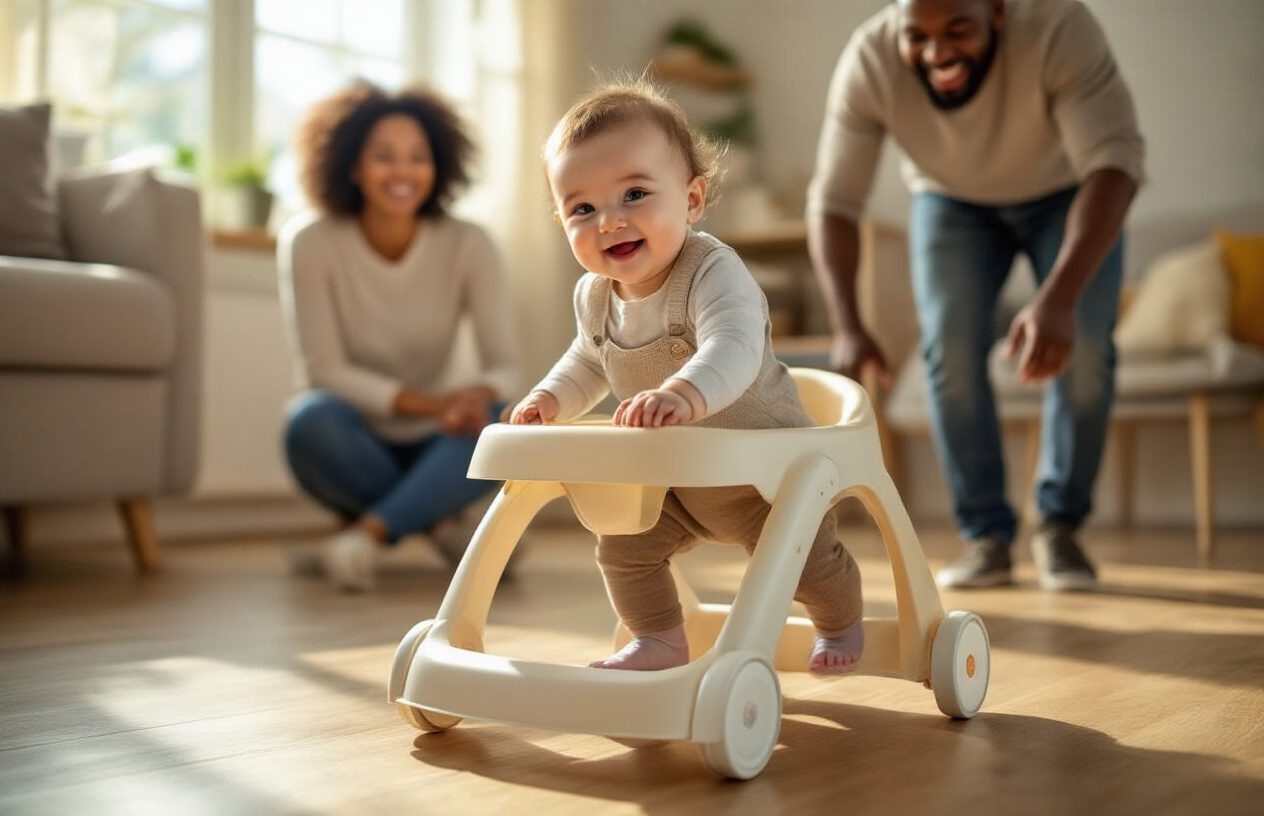
Choosing a baby walker that supports your child’s development while keeping safety at the forefront requires careful consideration of several factors.
From understanding developmental readiness to evaluating key features like adjustable height, comfortable seats, and engaging activity centers, parents have numerous options to explore.
Whether you prefer traditional walkers, sit-to-stand models, or push walkers, each type offers unique benefits tailored to different developmental stages.
Remember that safety should always be your top priority when selecting a baby walker. Look for models with wide, stable bases, reliable braking mechanisms, and appropriate certifications.
By taking the time to research and select the right walker for your child’s specific needs, you’ll provide them with a tool that not only entertains but also supports their exciting journey toward those first independent steps.